FormHarvester
Find business websites, read their contact pages, and work their forms.
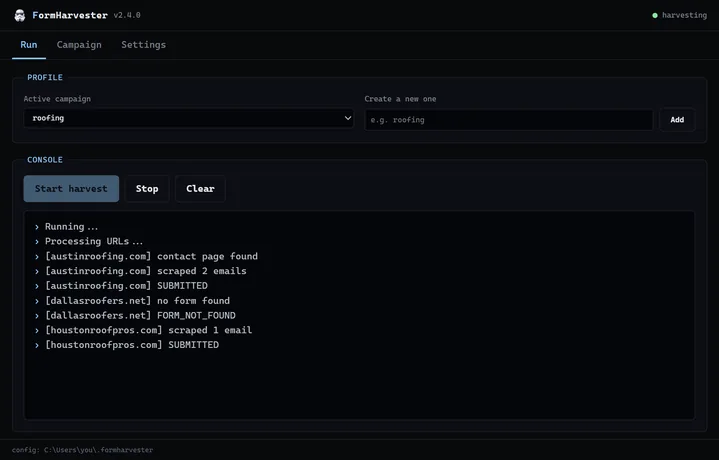
FormHarvester is an open-source form intelligence engine for outbound and lead-research work: it finds business websites, reads their contact pages, detects the technologies they run, and fills their contact forms in a real browser.
It navigates the open web through a real Chrome session: it runs searches, normalises and deduplicates the results, visits contact and landing pages, extracts public contact signals with the source URL each one came from, and can compose and submit contact forms on your behalf.
It is aimed at outbound and lead-research work, and ships two ways — a signed Windows desktop
app, and pip install formharvester for the CLI and Python API.
Two design choices are worth calling out. Technology detection runs locally — no Wappalyzer, no hosted API, no browser extension — and reports a name, category, version, confidence score and human-readable evidence per site, reading cookies by name only and never writing their values into evidence. Form content is LLM-generated but tightly scoped: the prompt receives structured context only, never raw HTML, cookies, scripts or page source, and the provider is yours to pick (OpenAI, Anthropic or DeepSeek).
Autopilot is gated rather than enthusiastic: deterministic lead scoring with a threshold, technology rules, a contact-form requirement, per-domain cooldowns, daily and per-run limits, review-before-submit on by default, and a dry-run mode that makes submission impossible.
How it compares
FormHarvester sits between three categories and replaces none of them outright.
Against technology-detection services such as Wappalyzer or BuiltWith: detection here runs locally, with no hosted API, extension or account, and every finding carries a confidence score and human-readable evidence rather than a bare verdict. It recognises fewer technologies than a commercial fingerprint database.
Against general scraping frameworks such as Scrapy, Apify or Octoparse: FormHarvester is not a general extraction tool. It has no scheduling, no proxy rotation and no managed infrastructure. What it does have is one vertical carried end to end.
Against outbound platforms such as Apollo, Clay or Hunter: there is no verified-contact database here, no CRM, no email sequencing and no deliverability tooling. FormHarvester works the contact-form channel rather than the inbox, and it is the only one of the group whose source you can read.
Reach for something else if you need a managed proxy pool, a contact database, or email sequencing.
BUILT BY Dario Mory
STATUS Shipped — v3.0.0
PRICING Free · MIT
PLATFORM Windows desktop app, Python package
STACK Python, Selenium, pywebview, PyInstaller
INSTALL pip install formharvester
WEBSITE formharvester.com
GITHUB dariomory/formharvester
Questions
Is FormHarvester free?
Yes. FormHarvester is MIT-licensed and free in both distributions — the signed Windows desktop app and the formharvester Python package. There is no paid tier and no account.
What platforms does it run on?
The desktop app is Windows-only. The Python package runs on Windows and Linux and gives you the same engine through a CLI and a Python API.
How do I install it?
Run pip install formharvester for the CLI and Python API, or download the signed desktop build from formharvester.com. Both need a local Chrome installation, because the engine drives a real browser session rather than issuing bare HTTP requests.
Do I need an API key?
Only for form composition, which uses an LLM you supply — OpenAI, Anthropic or DeepSeek. Search, extraction and technology detection need no key and no account.
Does it send page data to a third party?
Technology detection runs entirely locally, with no hosted API and no browser extension. The only outbound call is the form-composition prompt, and it receives structured context only — never raw HTML, cookies, scripts or page source.
Does it read my cookies?
It reads cookie names only, as one technology-detection signal among several, and never writes cookie values into its evidence output.
Can it submit contact forms automatically?
Yes, through Autopilot, but it is gated by design: deterministic lead scoring against a threshold, technology rules, a contact-form requirement, per-domain cooldowns, daily and per-run limits, review-before-submit enabled by default, and a dry-run mode in which submission is impossible.
How is it different from a scraper or from Wappalyzer?
It is a single vertical rather than a general tool: find the site, read its contact surface, detect its stack, work its form. It has no scheduling, proxy rotation or managed infrastructure like a scraping framework, and it detects fewer technologies than a commercial fingerprint database — but detection is local and every finding carries a confidence score and readable evidence.