matadore
Security scanners give you a list. The aim here is a story.
This one is pre-alpha, and the honest version matters more than the pitch. matadore is
published to PyPI and has a full documentation site, but it does not perform scans today. The
entry point, all six input handlers, all five tool plugins and every report method currently
raise NotImplementedError, and the command-line interface is still scaffolding. Treat it as a
design worked out in the open, not a tool to reach for.
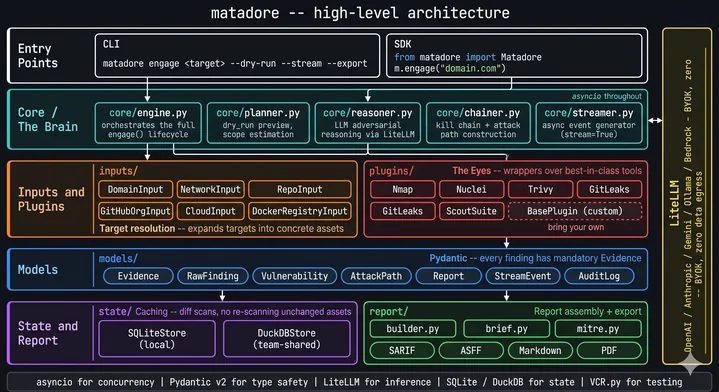
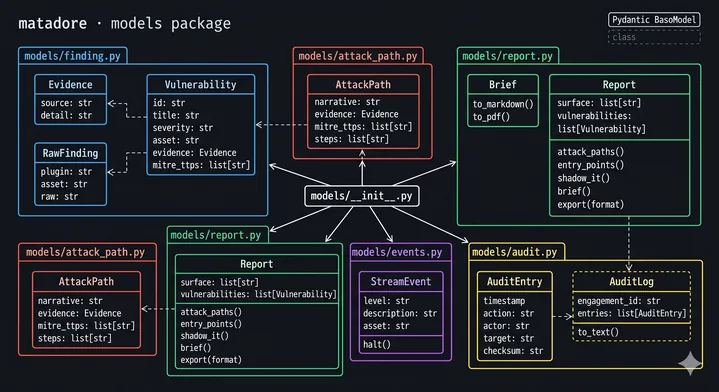
What exists is the skeleton: the Pydantic domain models, a dry-run planner that describes exactly what an engagement would touch, a state store over SQLite with optional DuckDB for team-shared runs, a multi-provider LLM client through LiteLLM, and a test suite around all of it.
The intent is adversarial reasoning rather than another checklist — chaining findings into narrative attack paths mapped to MITRE ATT&CK, across domains, network ranges, repositories, GitHub organisations, cloud accounts and container registries, wrapping existing tools rather than replacing them. Two constraints are baked into the models: every finding must carry a verifiable evidence reference, and inference can run entirely locally through Ollama, so nothing has to leave your network.
The diagrams below are the intended architecture and the model layer as designed — the models are real code, the boxes around them mostly are not yet.
Progress is tracked in the open on GitHub.
BUILT BY Dario Mory
STATUS Pre-alpha — not yet functional
PRICING Free · MIT
PLATFORM Python package
STACK Python 3.12+, typer, litellm, pydantic
WEBSITE dariomory.github.io/matadore/
GITHUB dariomory/matadore
Questions
Can I use matadore today?
No. It does not perform scans. The entry point, all six input handlers, all five tool plugins and every report method raise NotImplementedError, and the command-line interface is still scaffolding.
It is on PyPI though — should I install it?
Only to read it. Version 0.1.0 is published and documented, but treat it as a design worked out in the open rather than a tool to reach for.
What actually exists in the codebase?
The Pydantic domain models, a dry-run planner that describes exactly what an engagement would touch, a state store over SQLite with optional DuckDB for team-shared runs, a multi-provider LLM client through LiteLLM, and a test suite around all of it.
What is it intended to do?
Adversarial reasoning rather than another checklist — chaining findings into narrative attack paths mapped to MITRE ATT&CK, across domains, network ranges, repositories, GitHub organisations, cloud accounts and container registries, and wrapping existing tools rather than replacing them.
Would it send my infrastructure data to an LLM provider?
Not necessarily. Inference goes through LiteLLM, so the provider is yours to choose, and it can run entirely locally through Ollama — nothing has to leave your network. That constraint is baked into the design rather than added later.
Is it free?
Free and MIT licensed.
Where can I follow progress?
Progress is tracked in the open on GitHub.