Shopify for GitHub
Commerce context for GitHub issues.
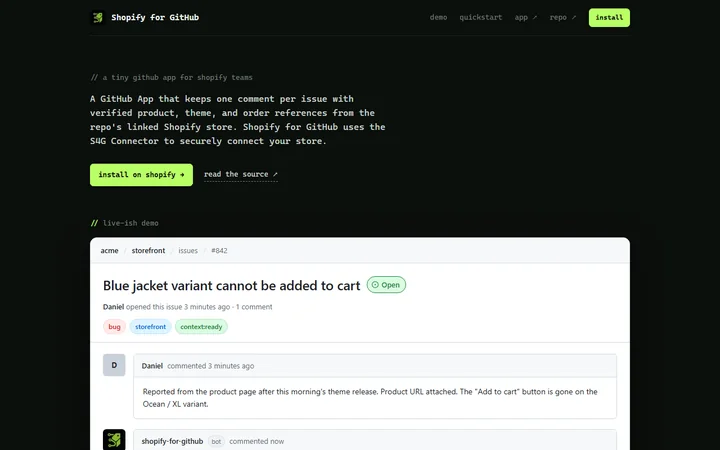
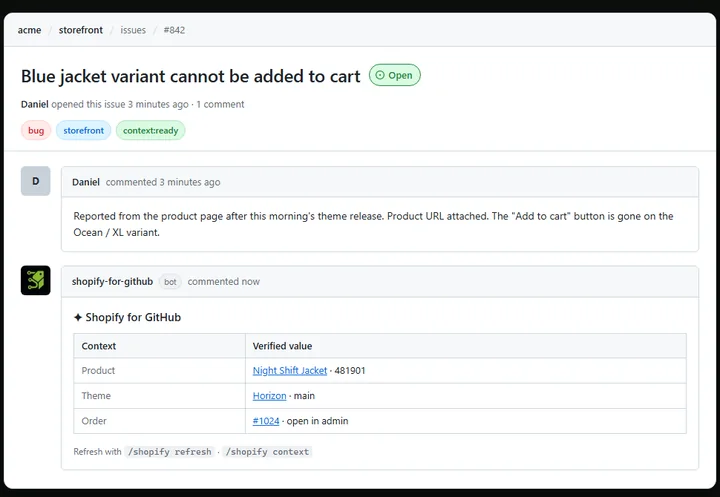
Shopify for GitHub is a GitHub App that turns vague store bug reports into developer-ready issues, by resolving product, theme and order references from the connected Shopify store.
Store bug reports arrive vague. “Checkout is broken on the sale page” does not tell a developer which product, which theme, or which order. Shopify for GitHub turns those into developer-ready issues by resolving the references automatically.
It maintains exactly one canonical comment per GitHub issue, carrying verified product, theme and order references pulled from the store connected to that repository — an order becomes an ID plus a deep link into the admin. Two slash commands in an issue comment drive it, one to build context and one to refresh it. Repositories without their own connection fall back to the most recently connected store in the same installation.
It is deliberately incurious about everything else. On GitHub it asks only for Issues read and write, so it cannot see your code. Order access is limited to the ID, name-number and an admin link — no customer fields, no payment details. Tokens are encrypted at rest, and uninstalling from either side wipes the credentials and mappings.
It is listed on the GitHub Marketplace as S4G Connector, which is the same app under a name that keeps the store’s trademark out of the listing title.
Not affiliated with, endorsed by, or sponsored by Shopify.
Currently in beta while the app listing goes through review.
Its development was inspired by commerce integration work on client systems — see the Cartechelectronics project — where the recurring problem was getting store context in front of whoever had to act on it.
How it compares
Against doing it by hand, which is the real incumbent: someone opens the admin, finds the order, copies the ID and pastes a link into the issue. This does that automatically and keeps it in one comment that stays current.
Against general automation such as Shopify Flow or Zapier: those can post to GitHub, but they fire on store events and append a comment each time. The unit here is the issue rather than the event — one comment per issue, refreshed on demand, with the references verified against the store rather than pasted as text.
It is narrow on purpose. Shopify only, issues only, and by design it cannot see your code.
BUILT BY Dario Mory
STATUS Beta — awaiting app review
PRICING Not published — free during beta
PLATFORM GitHub App
STACK Next.js 15, Vercel, Postgres, Google Gemini
WEBSITE shopify.mory.dev
GITHUB dariomory/shopify-for-github
Questions
Can I install it today?
It is in beta while the app listing goes through review, and free during beta.
Why is it called S4G Connector on the GitHub Marketplace?
It is the same app under a name that keeps the store trademark out of the listing title. It is not affiliated with, endorsed by or sponsored by Shopify.
Can it see my code?
No. On GitHub it requests only Issues read and write, so repository contents are outside what it can access at all.
What order data does it touch?
Only the order ID, the name-number, and a deep link into the store admin. No customer fields and no payment details. Tokens are encrypted at rest.
How do I use it on an issue?
Two slash commands in an issue comment drive it — one to build the commerce context, one to refresh it.
Will it clutter my issue threads?
No. It maintains exactly one canonical comment per issue and updates that comment in place rather than adding new ones.
What if a repository has no store connected?
It falls back to the most recently connected store in the same installation, so a multi-repository setup does not need a connection wired up per repository.
What happens when I uninstall it?
Uninstalling from either side wipes the stored credentials and the repository to store mappings.